

Hey there! As a supplier of Mobile Hydraulic Jacks, I often get asked about the reaction force during the lifting process. So, let's dive right into it and break down what exactly the reaction force of a mobile hydraulic jack is when it's doing its job of lifting heavy stuff.
First off, you gotta understand the basic principle of a mobile hydraulic jack. It works on Pascal's law, which states that when pressure is applied to a confined fluid, the pressure change occurs throughout the entire fluid. In a hydraulic jack, you've got a small piston and a large piston connected by a tube filled with hydraulic fluid. When you apply force to the small piston, it creates pressure in the fluid, and this pressure is transmitted equally to the large piston. Since the large piston has a bigger surface area, it can generate a much larger force to lift heavy loads.
Now, let's talk about the reaction force. According to Newton's third law of motion, for every action, there is an equal and opposite reaction. When the mobile hydraulic jack exerts an upward force on the load it's lifting, there's a corresponding reaction force that acts in the opposite direction. This reaction force is crucial to understand because it affects how the jack interacts with its surroundings and how stable it is during the lifting process.
The reaction force of a mobile hydraulic jack during lifting is essentially the force that the jack experiences in response to the force it applies to the load. For example, if you're using a mobile hydraulic jack to lift a car that weighs 2000 kilograms, the jack has to exert an upward force of at least 2000 kilograms (or the equivalent in Newtons, which is about 19600 N, since 1 kg = 9.8 N) to lift the car off the ground. In return, the car exerts a downward reaction force of the same magnitude on the jack.

This reaction force has several important implications. One of the most obvious ones is stability. The jack needs to be able to withstand this reaction force without tipping over or collapsing. That's why mobile hydraulic jacks are designed with a wide base and a sturdy frame. The wider the base, the more stable the jack is, as it distributes the reaction force over a larger area. Additionally, the materials used in the construction of the jack, such as high - strength steel, are chosen to be strong enough to handle the reaction force.
Another aspect to consider is the surface on which the jack is placed. The reaction force is transferred from the jack to the ground through its base. If the surface is uneven or soft, it can cause the jack to sink or tilt, which can be extremely dangerous. That's why it's always recommended to place the jack on a flat, hard surface like concrete or asphalt.
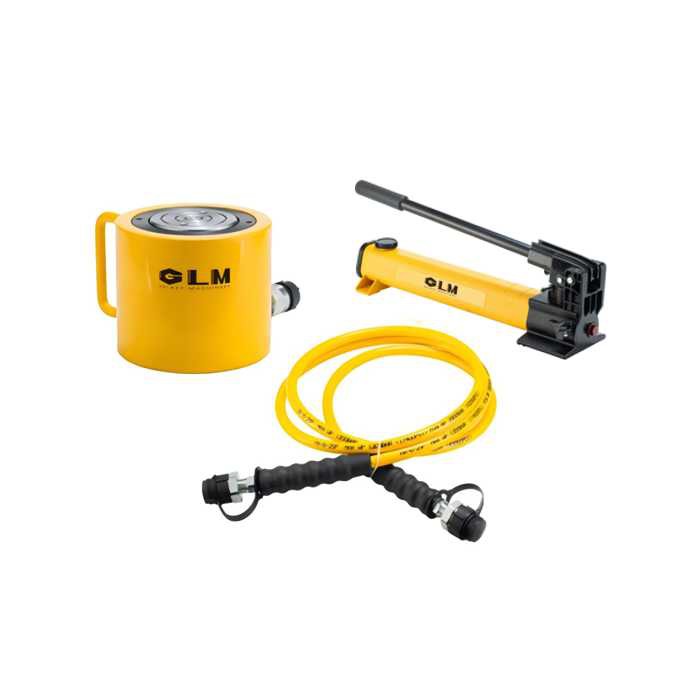
Now, let's take a look at some of the products we offer as a Mobile Hydraulic Jack supplier. We have a great range of hydraulic jacks that are designed to handle different loads and applications. For instance, our Hydraulic Pusher is a powerful tool that can be used for pushing or lifting heavy objects. It's built with high - quality components to ensure reliable performance and can withstand the reaction forces associated with heavy - duty tasks.
Our RCS Hydraulic Cylinder And Manual Pump Set and RCS Hydraulic Cylinder And Hand Pump Set are also popular choices. These sets are compact and easy to use, making them ideal for various lifting and pushing applications. They are designed to provide a consistent and reliable force, and their robust construction can handle the reaction forces generated during operation.
When it comes to choosing the right mobile hydraulic jack, you need to consider the maximum load you'll be lifting. Make sure to select a jack with a capacity that exceeds the weight of the heaviest load you plan to lift. This will not only ensure that the jack can handle the load but also that it can safely withstand the reaction force.
It's also important to follow the proper safety procedures when using a mobile hydraulic jack. Always read the manufacturer's instructions carefully before use. Check the jack for any signs of damage or wear before each use. And never exceed the recommended load capacity of the jack.
In conclusion, understanding the reaction force of a mobile hydraulic jack during lifting is essential for safe and effective operation. As a supplier of mobile hydraulic jacks, we take great care in designing and manufacturing our products to ensure that they can handle the reaction forces associated with lifting heavy loads. Whether you're a professional mechanic or a DIY enthusiast, having the right mobile hydraulic jack for the job is crucial.
If you're in the market for a high - quality mobile hydraulic jack, don't hesitate to reach out to us. We're here to help you find the perfect product for your needs. Whether you need a small jack for light - duty tasks or a heavy - duty jack for industrial applications, we've got you covered. Contact us today to start the procurement process and let's have a chat about how we can meet your requirements.
References
- Halliday, D., Resnick, R., & Walker, J. (2014). Fundamentals of Physics. Wiley.
- Tipler, P. A., & Mosca, G. (2008). Physics for Scientists and Engineers. W.H. Freeman and Company.


